What’s covered
- What is GPT-6 Astra?
- How much better is GPT-6 Astra at translation?
- Does a higher benchmark score mean better output for your product?
- What could Astra’s stronger instruction-following mean for AI localization tools?
- Frequently asked questions
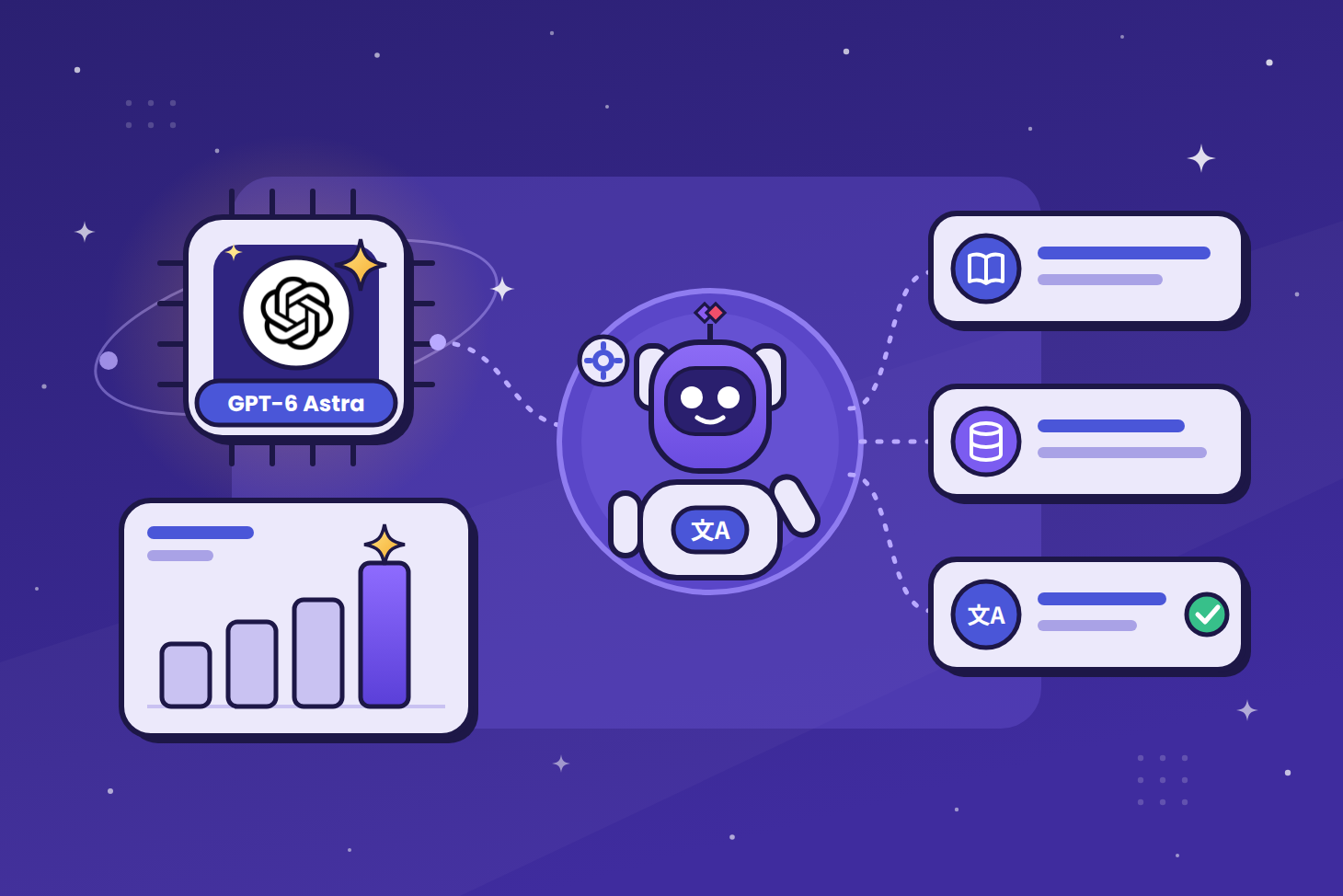
GPT-6 Astra just posted the highest score of any model on M-GATE, RWS’s ongoing AI translation benchmark. For a localization team, the more useful question isn’t the score itself. It’s what a new, higher-scoring model actually changes about how translation work gets done day to day. Here’s what the record means, and what it doesn’t.
What is GPT-6 Astra?
GPT-6 Astra is OpenAI’s newest flagship model, a general-purpose reasoning model rather than a translation-specific tool. It launched on September 3, 2026, in a staged rollout to ChatGPT and API users, calling it the “most intelligent and aligned model” it has built.
OpenAI built Astra’s headline improvements around computer use, cybersecurity and software engineering rather than translation, because the model is designed as a general-purpose reasoning system, not a language-specific tool. Translation is one of many areas it happens to get tested on, not a primary design target, which helps explain why its gains land unevenly by language rather than uniformly across the board. Notably, OpenAI did not publish its own translation or multilingual benchmark results at launch, as Slator pointed out, so what we know about its translation performance comes entirely from third-party testing.
How much better is GPT-6 Astra at translation?
Astra scored 4.37 out of 5 on M-GATE’s translation task, the highest of any model tested, with several language-level records set alongside it.
Here’s what changed between GPT-5.5 and GPT-6 Astra, according to RWS and Slator’s testing:
- Translation score rose from 4.28 to 4.37 out of 5, with statistically significant new highs in five languages: Dzongkha, Basque, Kinyarwanda, Tamil and Tagalog. It also regressed in Finnish compared to the previous model.
- Grammar score rose from 0.17 to 0.38 MCC (Matthews correlation coefficient, a stricter measure of grammatical correctness that runs from -1 to 1 and accounts for both false positives and false negatives), closing most of the gap to the current leaders.
- Token usage dropped by roughly 30% at the same per-token price, lowering the effective cost per translation.
- Instruction-following and structured reasoning improved broadly across the model, which is part of what's driving the grammar gain above, though OpenAI hasn't published a dedicated benchmark isolating that capability on its own.
That grammar gain puts Astra statistically level with Anthropic’s Claude Fable 5.1 and Google’s Gemini 3.1 Pro, because instruction-following and structured reasoning improved across the model generally, not just its multilingual output. It still lags on some high-resource languages, including Polish, Japanese and Thai.
A separate, harder benchmark makes the “how good is good enough” question sharper. The Last Translation Benchmark, built from real cases that have broken leading translation systems, ranks Astra ahead of other models tested, but its standard and pro configurations passed only around 44 to 45% of the benchmark’s difficult cases, per Slator’s reporting. That doesn’t mean Astra fails most ordinary translation requests. It means the hardest, most ambiguous cases, the kind that actually cause rework in production, still trip it up more often than not.
That efficiency gain compounds at scale: Astra’s lowest reasoning setting still outperformed every other tested model on translation, at a fraction of the cost of running its own top setting, which matters more for high-volume batches than for a handful of one-off strings.
Does a higher benchmark score mean better output for your product?
Not on its own, and the benchmark methodology itself points at why. M-GATE’s translation task measures round-trip translation: how much meaning survives when English text is translated out and back again. As Slator noted, that’s an indirect measure of quality: it scores the final English output, not the accuracy, grammar or naturalness of the actual target-language text, and it doesn’t test translation between two non-English languages at all.
A benchmark score reflects how well a model translates general text in a controlled test, not how well it matches your product’s established terminology, tone and prior translations, because the evaluation text carries no memory of your project’s glossary or style guide. A newer, higher-scoring model can still drift from terminology a team has already approved, simply because it was never given that material to work from. A general-purpose model like Astra is well suited to broad reasoning and instruction-following across many tasks, while a project’s own translation memory and glossary are what keep translated output consistent with what a team has already approved.
This isn’t a new problem that Astra solves or introduces. Nimdzi Insights has found that almost half of all translation rework traces back to improper terminology management, regardless of which engine or model produced the translation in the first place. Translation quality improves when a model has access to a project’s existing translation memory and glossary, because it can reuse approved terminology and phrasing instead of generating a new, plausible-sounding alternative each time. We’ve covered the mechanics of this in more depth in how to improve AI translation quality. The short version: a stronger base model raises the ceiling on how well it can follow that context when it’s given. It doesn’t remove the need to provide it.
What could Astra’s stronger instruction-following mean for AI localization tools?
The grammar and structured-reasoning gains above suggest Astra follows detailed instructions and templates more consistently, and is better at selecting the specific piece of context relevant to a given task, even without a dedicated benchmark measuring that capability on its own. If that holds up in production, it points toward a system that navigates content, checks it in context and acts on what it finds, rather than only generating text from a single prompt. That kind of gain matters more for agent-based localization workflows that feed a model structured context, glossaries and instructions repeatedly across a project, than for a one-off translation prompt, because there’s more relevant material for the model to act on consistently across a whole batch.
This mirrors a broader shift industry analysts are pointing to across enterprise software: as generating code and interfaces gets easier and cheaper with AI, value is migrating to whichever layer holds the institutional context that tells an agent what to do and whether it’s allowed to do it (The Leverage). The same logic applies at the level of a single translation task. The model executes. The context, glossary and instructions direct it.
Localization Agent, Gridly’s AI agent for translation, cross-language quality checks and other localization tasks, works from a project’s existing translation memory, glossary and other resources rather than translating in isolation, and every instruction it runs on is testable on a sample before it touches a full batch. A more capable underlying model like GPT-6 Astra simply raises what that setup can do with the context it’s given. That’s a step toward agentic localization: an AI agent that works toward a localization goal, selects its own context, and keeps track of project decisions across a job, rather than a model executing one prompt at a time.
Learn more about Localization Agent or book a demo for a closer look.
Frequently asked questions
What is GPT-6 Astra?
GPT-6 Astra is OpenAI’s latest flagship large language model, released on September 3, 2026, with improved reasoning, instruction-following and agentic capability compared to earlier GPT models.
Is GPT-6 Astra better than other leading models at translation?
On the M-GATE benchmark, GPT-6 Astra scored highest on translation and was statistically tied with Claude Fable 5.1 and Gemini 3.1 Pro on grammar. On the harder Last Translation Benchmark, it ranked first but still failed more than half of the test’s difficult cases.
Does a smarter AI model remove the need for a glossary in translation?
No. Nimdzi Insights has found that almost half of translation rework stems from improper terminology management, independent of which model or engine is used. A glossary and translation memory still determine whether output stays consistent with what a team has already approved.
Is GPT-6 Astra more expensive to run than previous models?
Astra is priced the same per token as other frontier-tier models but used about 30% fewer tokens than its predecessor in testing. Lower reasoning settings cost significantly less while still leading on translation.
Author

Quang Pham
Quang has spent the last 5 years as a UX and technical writer, working across both B2C and B2B applications in global markets. His experience translating complex features into clear, user-friendly content has given him a deep appreciation for how localization impacts product success.
When he's not writing, you'll likely find him watching Arsenal matches or cooking.